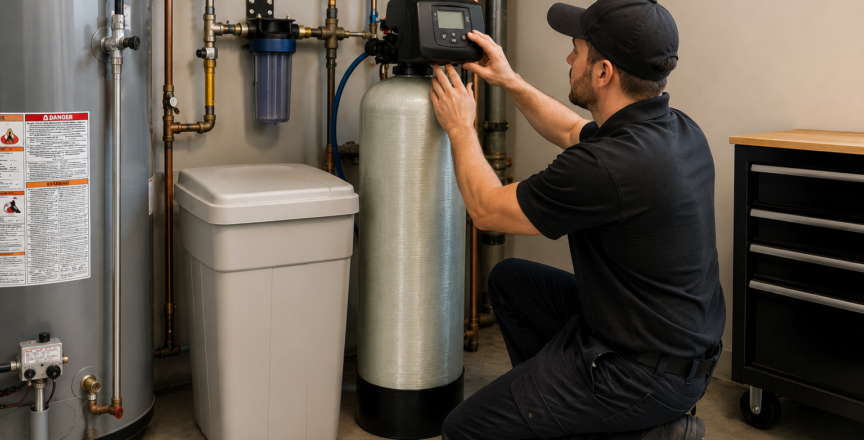
Let’s be honest: nobody spends their weekend thinking about their utility room—until their tap water starts destroying their fixtures, ruining their laundry, or drying out their skin.
If you are reading this, you are probably wondering what does a water softener do, whether your home needs one installed for the first time, or if your old unit has finally kicked the bucket.
As a local water softener company with over 30 years of experience working in real Edmonton basements, we see the damage untreated hard water causes every single day.
Before you run out to buy a water softener or sign an expensive corporate rental contract, let’s look at how our local water affects your home, the warning signs of a failing system, and how a professional water softener installation company can protect your plumbing.
A household water softener is a whole-house system built to strip hard mineral ions out of your water supply. In the Edmonton region (including Strathcona County, St. Albert, and Spruce Grove), our water comes from the North Saskatchewan River and is treated by EPCOR. While it is clean and safe to drink, it is naturally moderately hard to hard.
Our water hardness typically sits between 100 and 200 mg/L (about 7 to 12 grains per gallon). This mineral density isn’t static—it shifts with the seasons, often spiking during dry spells and deep winter freezes.
The real issue happens when hard water gets heated inside your hot water tank, dishwasher, or plumbing lines. The dissolved minerals turn into a rock-hard layer of crust called limescale. Over time, this scale chokes your pipes and forces your water heater to burn significantly more energy just to heat your water. Installing a high-efficiency water softener for home use stops this buildup completely.
Whether your home is currently completely untreated or you suspect your existing unit is just taking up space, your plumbing will tell you when it’s time to invest in a new system or learn how to replace water softener hardware. Here is what a professional water softener installation company looks for:
When calcium mixes with soap, it creates a sticky film. If you are constantly scrubbing a stubborn white, cloudy layer off your glass shower doors, tile grout, or kitchen faucets, your water supply is fighting your cleaning efforts. When a residential water softener is running correctly, soaps rinse away cleanly without leaving a trace.
If your wine glasses and plates come out of the dishwasher looking hazy or covered in white streaks, it isn’t a problem with your detergent. It is the literal mineral rock left behind as the water evaporates during the dry cycle.
Hard water minerals embed themselves deep into clothing fibers. If your bath towels feel stiff and rough like sandpaper, or your dark clothes look dull and worn out after only a few washes, raw minerals are wearing out your fabrics prematurely.
Hard water strips away the natural moisture barriers of your skin and scalp, which can trigger or worsen conditions like eczema. If your family notices a tight, dry sensation after showering, or if your hair feels brittle and difficult to manage, mineral residue is the culprit. Soft water from a water softener whole house setup lathers effortlessly, meaning you can typically cut your soap and shampoo usage in half.
Take a close look at the aerators on your sinks or the nozzles on your shower head. If you see a hard, greenish-white crust blooming around the openings and your water pressure has slowly dropped over time, those minerals are physically plugging the holes. The exact same restriction is happening silently inside your hidden pipes.
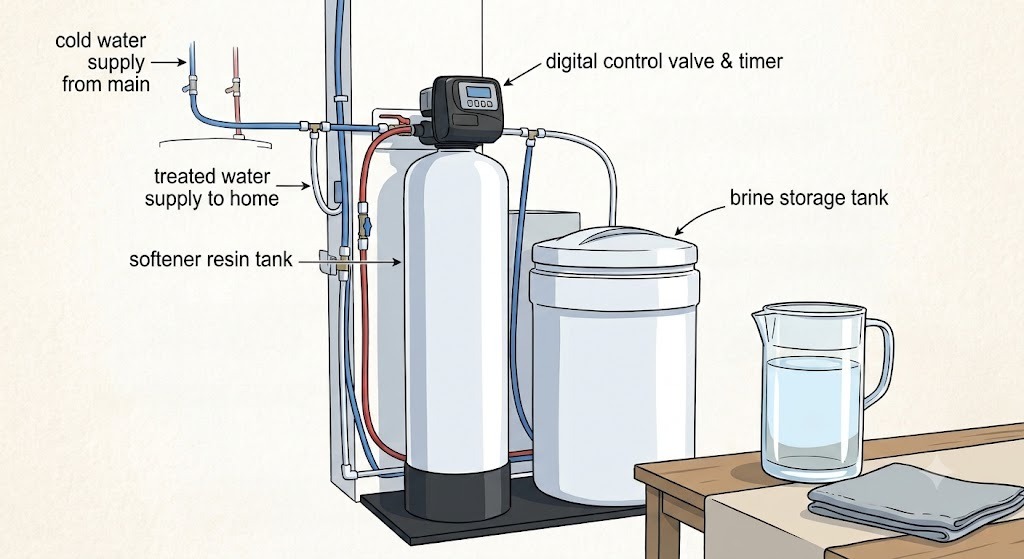
Many homeowners ask us to explain: how does a water softener work? It’s important to understand that a softener is not a standard filter that strains out dirt. Instead, a true water softener for entire house coverage relies on a process called ion exchange.
So, how does a water softener system work behind the scenes? The unit uses two distinct tanks: a tall mineral cylinder packed with specialized resin beads and a shorter brine storage tank where you add your salt.
There is a lot of confusing information online regarding a salt free water softener or a saltless water softener. Let’s cut through the marketing spin and look at the actual physics of water treatment.
Mechanically speaking, there is no such thing as a salt-free water softener. These alternative systems are actually physical water conditioners. They do not extract a single milligram of calcium or magnesium from your home’s water supply. Instead, they just alter the structure of the minerals so they don’t stick to the inside of your pipes as easily.
Picking a traditional, salt-based system is usually what’s best for local households. While conditioners are helpful in a variety of ways—especially for consumers with strict sodium diets who are concerned about salt in their water—conditioners are simply less effective in regions with hard water profiles.
Because Edmonton’s water has substantial mineral content that shifts heavily throughout the year, a salt-free conditioner will not stop your skin from drying out, will not help your soap form a rich lather, will not protect your laundry from fading, and will not eliminate soap scum in your tub. For true, soft water benefits across your entire home, investing in traditional house water softener systems remains the only definitive solution.
A very common misunderstanding we hear out in the field is that a water softener will remove chemical smells or chlorine tastes from tap water. It won’t. Municipalities use chlorine strictly to sanitize the water lines as it travels to your neighborhood.
If your goal is to eliminate both raw mineral hardness and chemical odors, you can pair it with a high-efficiency under-sink reverse osmosis water filtration systems unit to give you pristine drinking water at the kitchen tap while the softener protects the appliances.
Successfully installing a water softener system in your property is not a casual DIY project; it involves cutting directly into your property’s main incoming water loop—right after your main water meter, but crucially before the plumbing line branches off to feed your water heater.
When our professional plumbing team hooks up a unit, we look at parameters that off-the-shelf instructions miss:
If your home has never had a water softener loop, installing one can completely transform your daily comfort and protect your property investment. Alternatively, if your current system is approaching the 10 to 15-year mark, its internal resin bed has likely degraded. This means it’s consuming twice as much salt and water as a modern system just to keep up, and it is likely time to look into how to replace water softener units.
At Butler Plumbing Heating & Gasfitting Ltd., we bring over 30 years of hands-on local service to every single project. We evaluate your mechanical room, test your incoming supply, and help you manage your water softener installation edmonton project for the long haul.
Ready to Protect Your Plumbing and Stop Scrubbing Scale? Don’t let hard water minerals cut the lifespan of your water heater and appliances short. Contact the certified, professionals at Butler Plumbing today to set up an honest, thorough water filtration assessment and installation quote for your property.
Contact Butler Plumbing Today for Your Professional Estimate